Customer-service agents
Coordinate conversation, records, policy, and documentation in one workflow.
A fictional agent workspace for practicing customer conversations, policy use, and clear next steps.
Launch the simulation ↗The dashboard brings the conversation, customer record, policy reference, and notes into one environment. The design asks learners to work a case rather than simply recall a rule.
This analysis was reconstructed from the supplied portfolio package. It does not claim original research findings, tested outcomes, or live AI capability.
A visual overview of the Waypoint experience.
Verify facts. Apply policy.
Agree the next step.
Coordinate conversation, records, policy, and documentation in one workflow.
Verify the customer, investigate the issue, choose an authorized action, and document follow-through.
Answer the call, inspect the order, consult policy, and respond by voice or text.
Compare your words with a suggested approach and examine why it helps.
Proposed rubric: accuracy, communication, policy use, and a documented next step.
The policy manual supports decisions. The two-page call guide supports call flow and case notes.
Reconstructed from the completed portfolio project. The assessment rubric is proposed; the current simulation provides guided reflection rather than automated performance scoring.
Agents need to verify facts, interpret policy, respond to the customer, and document an actionable next step. Placing these tasks together creates an opportunity to practice coordination across the workflow.
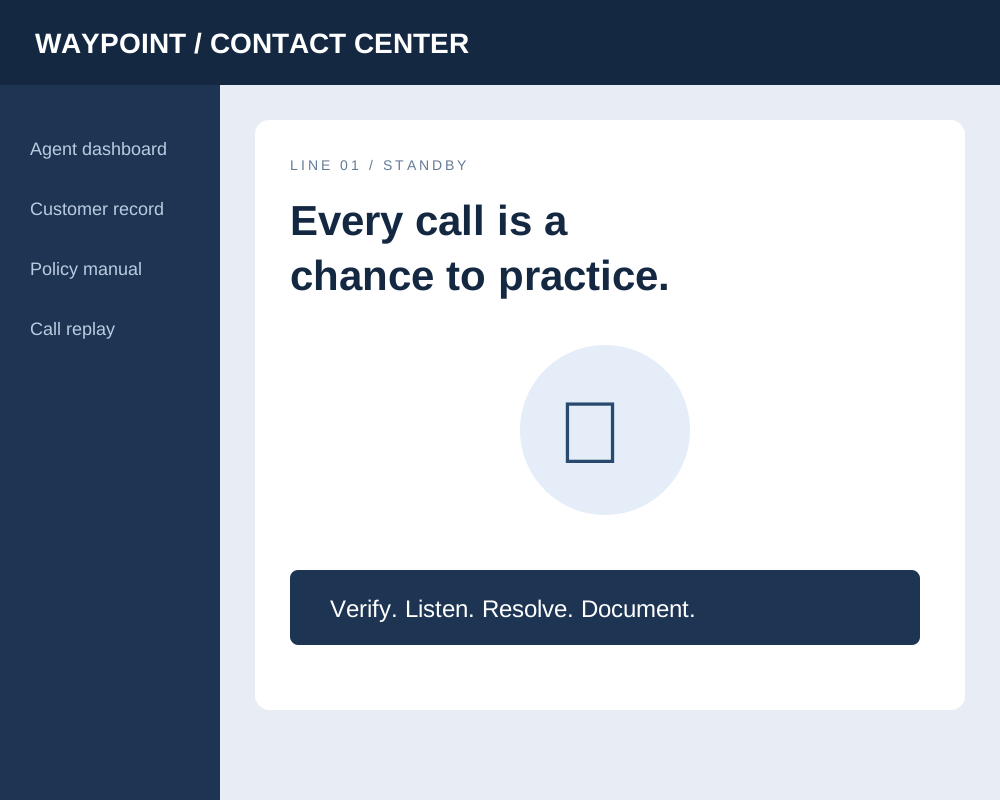
Navigation separates customer information, policy support, notes, and replay while keeping them within the same practice environment.
Illustrated dashboard preview, not a screenshot of a learner session.
Customer details appear after the learner answers, preserving the sequence of an incoming call. The record and policy provide information at the moment of need. Outcome documentation closes the loop before the learner returns to the queue.
Refund, exchange, and return situations give the learner concrete facts to investigate.
A policy manual supports decisions inside the workflow rather than requiring every rule to be memorized.
Browser speech features add conversational practice where supported. Typed responses provide another way to participate.
The supplied version uses scripted customer responses and browser text-to-speech. This keeps the portfolio demonstration self-contained. It does not provide unrestricted AI conversation or an AI performance rating.
Call replay lets learners compare one of their responses with a suggested approach and an explanation. This is guided reflection rather than an automated performance score.
Notes and outcome summaries provide artifacts for discussion. A facilitator could use a rubric to assess accuracy, communication, and follow-through.
| Performance goal | Current practice | Proposed evidence |
|---|---|---|
| Verify and investigate | Customer details and order record | Observe whether the learner confirms facts before acting. |
| Apply policy appropriately | Policy manual and case decisions | Review the selected outcome and rationale against the fictional policy. |
| Communicate a useful response | Scripted conversation and replay | Use a rubric for acknowledgment, clarity, and a specific next step. |
| Document the resolution | Case notes and outcome summary | Check that notes capture facts, action, and follow-up ownership. |
A pilot could identify navigation friction, policy misunderstandings, and weak documentation. A later unfamiliar case would help examine transfer beyond repeated scenarios.
Evaluation activities are proposed. No learner study, validated scoring rubric, or measured improvement is claimed. Voice features require browser support and permission.